Special Session on Quantum Computing


คำอธิบายรูปภาพ

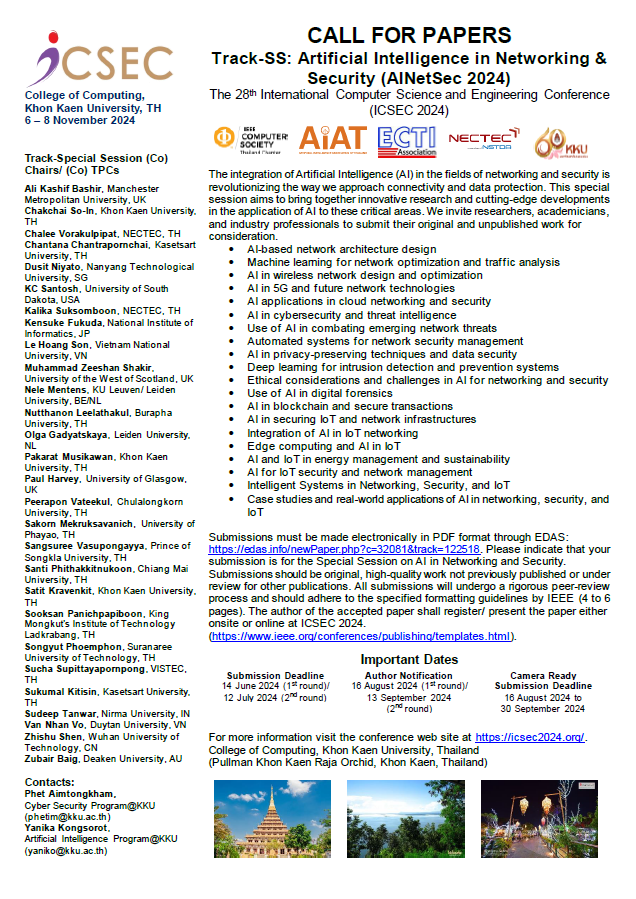
The integration of Artificial Intelligence (AI) in the fields of networking and security is revolutionizing the way we approach connectivity and data protection. This special session aims to bring together innovative research and cutting-edge developments in the application of AI to these critical areas. We invite researchers, academicians, and industry professionals to submit their original and unpublished work for consideration.
➤ Topic

• AI-based network architecture design • Machine learning for network optimization and traffic analysis
• AI in wireless network design and optimization
• AI in 5G and future network technologies
• AI applications in cloud networking and security
• Integration of AI in IoT networking• Kalika Suksomboon, NECTEC, TH
• Kensuke Fukuda, National Institute of Informatics, JP
• Le Hoang Son, Vietnam National University, VN
• Muhammad Zeeshan Shakir, University of the West of Scotland, UK
• Nele Mentens, KU Leuven/ Leiden University, BE/NL
• Nutthanon Leelathakul, Burapha University, TH
• Olga Gadyatskaya, Leiden University, NL
• Pakarat Musikawan, Khon Kaen University, TH
• Paul Harvey, University of Glasgow, UK
• Peerapon Vateekul, Chulalongkorn University, TH
• AI in cybersecurity and threat intelligence
• Use of AI in combating emerging network threats
• Automated systems for network security management
• AI in privacy-preserving techniques and data security
• Deep learning for intrusion detection and prevention systems
• Ethical considerations and challenges in AI for networking and security
• Use of AI in digital forensics
• AI in blockchain and secure transactions
• AI in securing IoT and network infrastructures

Special Session on Quantum Computing

Quantum computing is the next big thing in the world of technology. Over the past decades or so, leading international companies such as Google and IBM have been heavily invested in the development of quantum computer and quantum software. Research in quantum computation have skyrocketed into a new height. The vast power of quantum computation could be applied to solve computational problems that are currently out of reach by the currently most powerful supercomputer. Applications of quantum computation are tremendous, including optimization and artificial intelligence.


The topics of interest in this special session are, but not limited to, as follows:

1. Noisy intermediate-scale (NISQ) computation
2. Quantum computation in education
3. Quantum annealing/optimization
4. Quantum gate-based computation
5. Quantum communication
6. Quantum machine learning
7. Quantum cryptography


Special Session Chair :

Dr. Sanpawat Kantabutra, Center of Excellence in Quantum Technology, Chiang Mai University

Special Session on Cognitive Information Processing and Its Applications

Cognitive information processing (CIP) currently plays important roles in many applications such as attention, encoding, memory, artificial intelligence (AI), and cognitive computing latest advances in machine thinking. As well as the characteristics of the human visual system, its information and limitations must be first clearly studied, and the artificial systems should be then developed. In this session, we discuss the wide range topics of human cognitive functions, advancements, limitations, and possibility for artificial system development. The topics of interest that fascinating area of this session are as follows:

1. Understanding Human Cognition:

CIP provides insights into how humans perceive, process, and store information. By understanding these cognitive processes, designers of AI systems can develop interfaces that align with natural human cognition, making interactions more intuitive and user-friendly.

2. Adaptive Interfaces:

AI systems can utilize knowledge from CIP to create adaptive interfaces that adjust based on user behavior and preferences. This can enhance user experience by presenting information in a way that aligns with how individuals process and retrieve information.

3. Personalization and User Modeling:

CIP principles can be applied to create personalized AI systems that adapt to individual users' cognitive styles and learning preferences. This involves building user models based on cognitive information to tailor interactions and recommendations.

4. Natural Language Processing (NLP):

Leveraging CIP in AI HMI often involves advancements in NLP. Understanding how humans process and comprehend language allows AI systems to communicate more effectively with users, whether through speech recognition, chatbots, or natural language interfaces.

5. Attention and Focus in UI/UX Design:

Considering principles of attention from CIP, AI interfaces can be designed to prioritize information effectively, ensuring that users' attention is directed toward important elements. This is crucial for designing user interfaces that facilitate efficient information processing.

6. Memory Augmentation:

AI systems can assist in information retrieval and memory augmentation by leveraging cognitive principles. For example, AI-powered recommendation systems can anticipate users' needs based on their past interactions and preferences.

7. Emotion Recognition:

Understanding human emotions, a facet of cognitive processing, is important for creating emotionally intelligent AI systems. AI can be designed to recognize and respond to human emotions, enhancing the overall quality of interaction.

Topics of interests include (but are not limited to) the following:

•Human Perception,
•Social Perception,
•Human-Machine Interaction •Biomedical Information Processing,
•Cognitive Science and Applications,
•Biomedical Information Processing
•Cognitive Science and Applications

Special Session Co-chairs:

• Watanabe Katsumi, Waseda University, Japan.
• Roberto Caldara, University of Fribourg, Switzerland.
• Montri Phothisonothai, Kasetsart University, Thailand.


Special Session on Cognitive Information Processing and Its Applications

Cognitive information processing (CIP) currently plays important roles in many applications such as attention, encoding, memory, artificial intelligence (AI), and cognitive computing latest advances in machine thinking. As well as the characteristics of the human visual system, its information and limitations must be first clearly studied, and the artificial systems should be then developed. In this session, we discuss the wide range topics of human cognitive functions, advancements, limitations, and possibility for artificial system development. The topics of interest that fascinating area of this session are as follows:

1. Understanding Human Cognition:

CIP provides insights into how humans perceive, process, and store information. By understanding these cognitive processes, designers of AI systems can develop interfaces that align with natural human cognition, making interactions more intuitive and user-friendly.

2. Adaptive Interfaces:

AI systems can utilize knowledge from CIP to create adaptive interfaces that adjust based on user behavior and preferences. This can enhance user experience by presenting information in a way that aligns with how individuals process and retrieve information.

3. Personalization and User Modeling:

CIP principles can be applied to create personalized AI systems that adapt to individual users' cognitive styles and learning preferences. This involves building user models based on cognitive information to tailor interactions and recommendations.

4. Natural Language Processing (NLP):

Leveraging CIP in AI HMI often involves advancements in NLP. Understanding how humans process and comprehend language allows AI systems to communicate more effectively with users, whether through speech recognition, chatbots, or natural language interfaces.

5. Attention and Focus in UI/UX Design:

Considering principles of attention from CIP, AI interfaces can be designed to prioritize information effectively, ensuring that users' attention is directed toward important elements. This is crucial for designing user interfaces that facilitate efficient information processing.

6. Memory Augmentation:

AI systems can assist in information retrieval and memory augmentation by leveraging cognitive principles. For example, AI-powered recommendation systems can anticipate users' needs based on their past interactions and preferences.

7. Emotion Recognition:

Understanding human emotions, a facet of cognitive processing, is important for creating emotionally intelligent AI systems. AI can be designed to recognize and respond to human emotions, enhancing the overall quality of interaction.

Topics of interests include (but are not limited to) the following:

•Human Perception,
•Social Perception,
•Human-Machine Interaction,
•Biomedical Information Processing
•Cognitive Science and Applications

Special Session Co-chairs:

•Watanabe Katsumi, Waseda University, Japan.
•Roberto Caldara, University of Fribourg, Switzerland.
•Montri Phothisonothai, Kasetsart University, Thailand.